RAFEDESAN DESIGN
Systematic Thinking in Physical Space
Project Overview
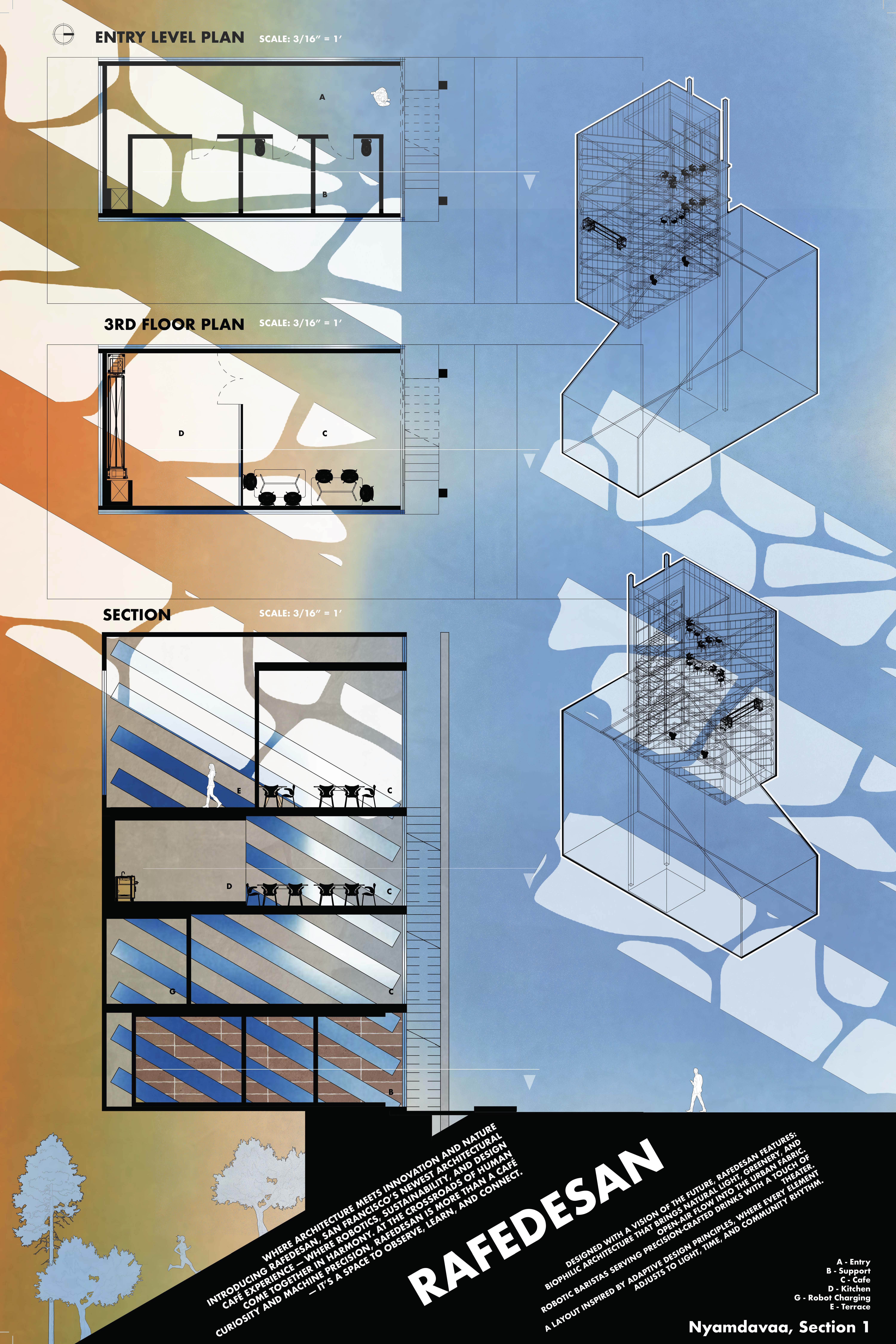
Rafedesan Café explores the provocative intersection of artificial intelligence and human dining experience. This project challenged me to design a space where service robots and humans share circulation paths, creating a futuristic café environment that harmonizes automation with warmth and social connection.
Situated on a sloped site on the outskirts of San Francisco, this 2,250 square foot café serves healthy dishes and smoothies while providing varied seating experiences—from formal dining to casual lounge arrangements. The design synthesizes technological innovation with human-centered hospitality, addressing the complex choreography of robotic service within an inviting architectural space.
Design Concept
My concept emerged from the question: How do we create architecture that celebrates both efficiency and humanity? I envisioned the café as a stage where technology serves rather than dominates—where robots glide through carefully planned service corridors while diners experience moments of surprise, comfort, and connection.
The spatial strategy creates distinct zones for human experience and robotic operation that occasionally intersect in choreographed moments. Natural light becomes a key player, flooding dining areas while robotic zones remain functionally lit. The architecture speaks to both precision (in circulation efficiency) and warmth (in material choices and spatial variation), embodying the café's dual mission of technological innovation and healthy living.
Project Meta
Skills
Spatial Strategy
- Designed dual circulation systems—one for patrons moving leisurely through entry, café, and terrace; another for robots efficiently moving between kitchen, charging station, and service points
- Created spatial hierarchy through ceiling height variation, level changes, and degrees of enclosure to distinguish entry arrival, café dining, and outdoor terrace experiences
- Leveraged the natural slope to separate public-facing spaces (upper levels with views) from service zones (lower levels integrated into hillside)
- Orchestrated solar access to optimize winter sunlight in 50% of the outdoor terrace while providing summer shading, and controlled café daylighting to prevent glare during all seasons
Human Experience
Despite the technological focus, I prioritized the emotional journey of the café visitor. The entry sequence deliberately turns away from the busy street, creating a moment of transition and arrival. Inside, the café offers diversity—intimate booths for conversation, communal tables for connection, bar seating for solo visitors, and lounge areas for relaxation.
Strategic window placement frames specific views while controlling light quality. The outdoor terrace extends the café experience into nature, blurring boundaries between interior and exterior. Throughout, the presence of service robots becomes a delightful surprise rather than an intrusion—they appear, serve, and retreat along their designated paths, enhancing rather than interrupting human interaction.
Technical Resolution
The project demanded rigorous technical problem-solving. I developed the structural system with basswood at 3/16" = 1'-0" scale, ensuring exterior walls measured 6-12 inches thick and floor/roof systems minimum 12 inches thick. All vertical circulation utilized stairs and ramps conforming to International Building Code requirements—no elevators allowed.
Site constraints became design opportunities: the prohibition against building into the hillside led to a terraced approach that creates dramatic spatial sequences. The 5-foot cantilever allowance over the northern sidewalk became a sculptural overhang marking the entry. Solar analysis diagrams at 37° north latitude informed every fenestration decision, balancing daylighting goals with thermal comfort.
Functional relationships between spaces followed strict logic: direct connections where efficiency mattered (kitchen to café, café to terrace), indirect connections where separation enhanced experience (kitchen visually/acoustically separated from café, robot charging accessed through kitchen rather than dining areas).